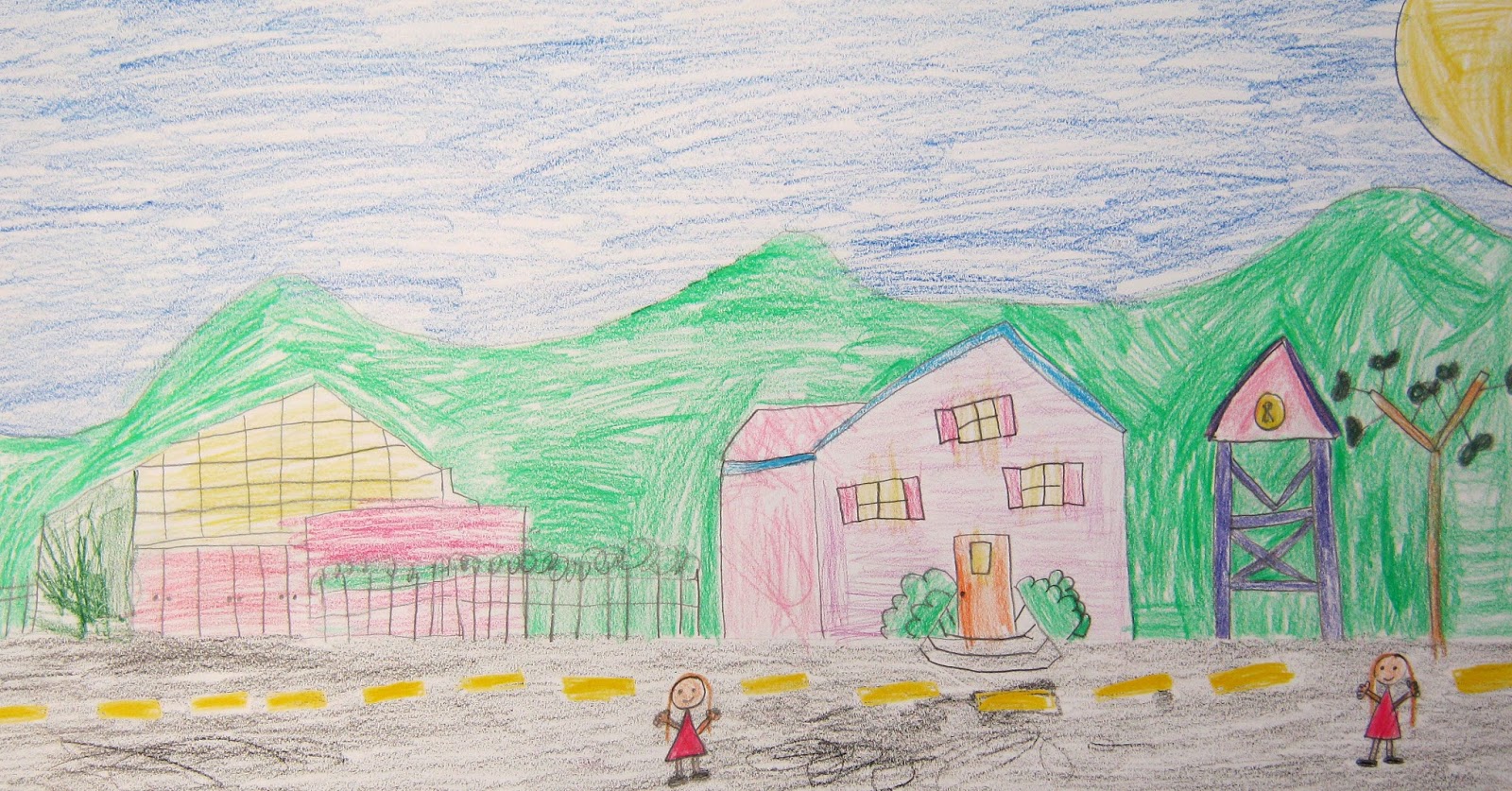
Second graders created landscapes of Ranney School. Can you recognize some of the buildings in Mia's illustration? Using creative choices for her colors, she drew the Commons, the Little White House (the art building) and the Clock Tower! Children are playing in the scene and it is a bright, sunny day.
Inspired by the artwork of Norman Rockwell (1894-1978), we saw how the amazing details of Rockwell's scenes help capture our interest and tell us a story about life in 20th century America. The image below is a street scene of Stockbridge, Massachusetts, the town where he lived. Norman Rockwell not only included the buildings on Main Street in Stockbridge, but he filled his painting with people and cars passing by to give us a feeling of life in the town. We can also tell it takes place during December by the Christmas decorations on the buildings, the bare trees outside, and the snow on the ground.
To create our landscapes, we looked carefully at the architectural details of the buildings on our campus. For the most part, the buildings all start off as a rectangle and many of them have a triangular roof just over the front door. Adding special details, such as the windows, the columns, a flag, a winter tree, a sign, and kids playing outside, help to tell our story of Ranney School. Here are some more wonderful examples of our landscapes! To see all of our work, follow this link to our exhibit page on artsonia.com. http://www.artsonia.com/schools/school.asp?id=114839
Drawing by Tyler
Drawing by Brooke
Drawing by Claire
Drawing by Jonathan
Drawing by Sydney
Note to families . . . This art blog will be updated regularly with new posts sharing our daily activities in the art room and news about upcoming art exhibits. To respect the privacy of our students, names will always be limited to first name only and identifiable photos will never be accompanied with a name. If you have any questions or comments, please feel free to write in the comment box below or send me an email at blevine@ranneyschool.org. I would love to hear from you! In my class, students are given the chance to explore different materials and fun new techniques as they develop their signature style. Some young artists love to draw with a pencil, some like to paint on canvas or create images in a digital format, while others prefer working with clay and molding three-dimensional forms. In my classroom, we use a variety of materials allowing all artists to experiment and figure out which type of art they like the best. At Ranney School, we place a strong emphasis on originality and celebrate artistic differences, always nurturing and encouraging the imagination of every student. Remember to check out our display of finished artwork and student portfolios in the Ranney home page of Artsonia.com. http://www.artsonia.com/schools/school.asp?id=114839
Crazy Hat Day? The Cat in the Hat knows a lot about that!
To celebrate Dr. Seuss' birthday on March 2 and 'Crazy Hat Day', Kindergarten artists drew a picture of a very familiar friend of theirs . . . a cat in a tall, striped hat! "The Cat in the Hat" is one of 44 books illustrated and written by Theodor Seuss Geisel (1904-1991), better known to all of us as the beloved Dr. Seuss.
In our drawings, we drew the famous cat wearing his tall hat and juggling objects as he balances on a ball. Here are more examples of our illustration. To see all of our cats, follow this link to our home page at artsonia.com... http://www.artsonia.com/schools/school.asp?id=114839
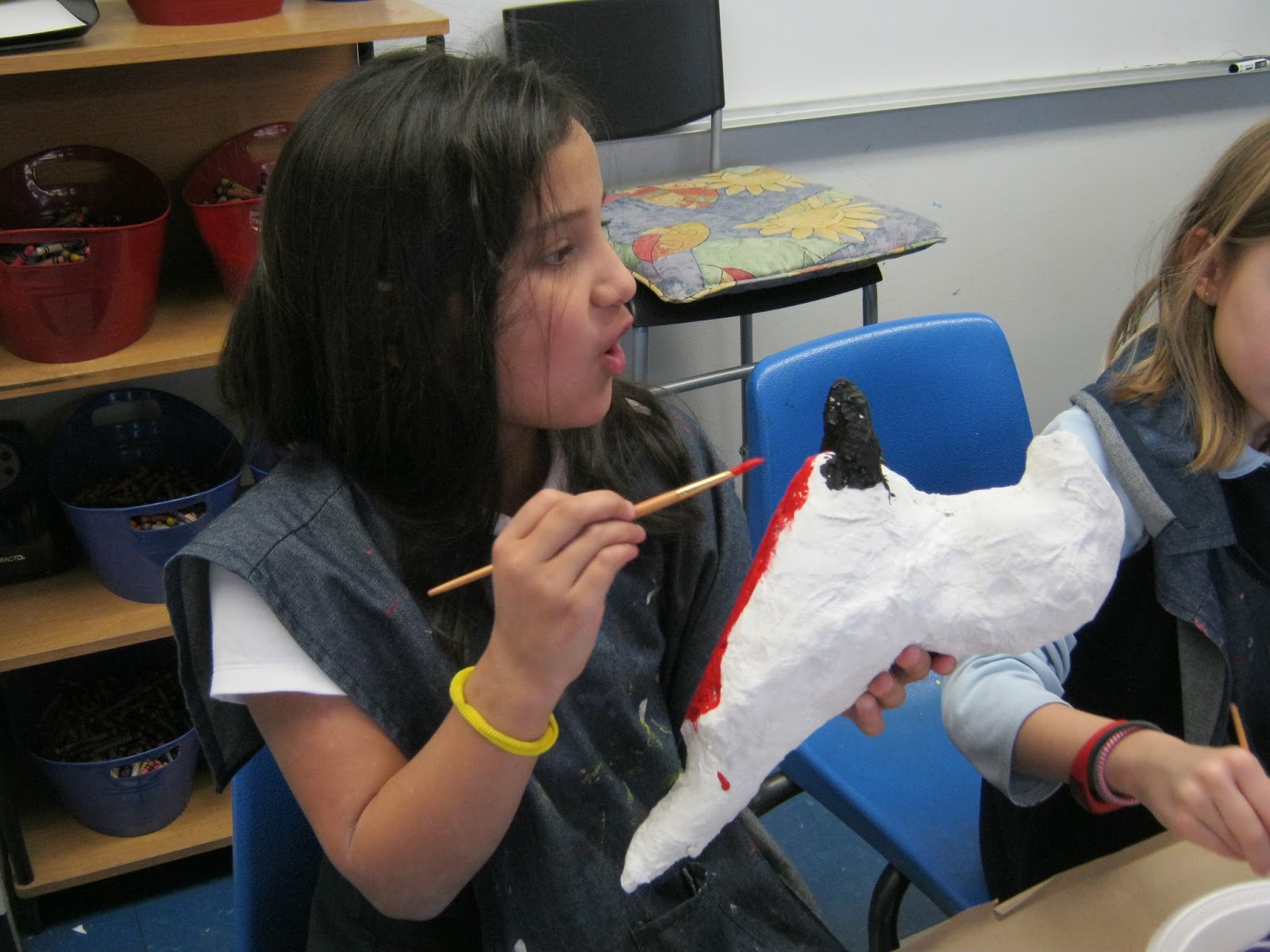
Our after school art club this session worked with materials to make 3 dimensional art! Beginning with photos of an animal each student selected on the computer with views from the front, the sides and the back, we created our animal forms with bundles of newspaper and masking tape.
After we were happy with the head, body, legs, ears and any other special detail of the animal, we covered them with plaster strips.
This was a messy but fun step! Small plaster strips were dunked in containers of warm water and wrapped around the animals. We worked in pairs for part of this step to make it easier to hold the animals still while wrapping them.
After the plaster dried, we had fun painting the animals. The bright paints really give our sculptures a bold and colorful personality!
Here are more pictures of our finished animal sculptures! To see them all and different views of each one, follow this link to our home page of artsonia.com http://www.artsonia.com/schools/school.asp?id=114839
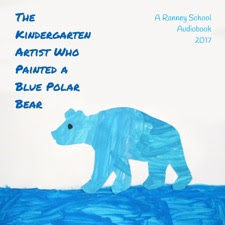
Congratulations to our Kindergarten artists! Our latest audiobook was published by iTunes to the iBookstore. "The Kindergarten Artist Who Painted a Blue Polar Bear" is available for you to download into your iBooks app on your iPhone, iPad, iPod touch or Mac computer. Each page features a painting based on the style of Eric Carle's illustration, along with a short story written and read aloud by our student artists.
Here is how the book is listed in iTunes...
Enjoy the creativity of our young artists at Ranney School!!
Description
This audiobook was created by the Kindergarten artists at Ranney School, Tinton Falls, NJ. The illustrations were inspired by the book, “The Artist Who Painted a Blue Horse,” by Eric Carle. The stories and audio are all presented by the student artists.
Requirements: This book was designed for an iOS device and some features may not work as intended with a mouse or trackpad. To view this book, you must have an iOS device with iBooks 3 or later and iOS 5.0 or later.
It might be a mild winter in New Jersey, but our penguins are enjoying a snowy day. Beginners practiced many art skills with this project. They used scissors to cut out their black penguin bodies and penguin feet. The snow in the background was made with their fingerprints and white paint. The furry penguin fur was made by gluing down soft, white cotton balls. To top it all off, they practiced writing their names in the sky!
Note to families... This art blog will be updated regularly with new posts sharing our daily activities in the art room and news about upcoming art exhibits. To respect the privacy of our students, names will always be limited to first name only and identifiable photos will never be accompanied with a name. If you have any questions or comments, please feel free to write in the comment box below or send me an email at blevine@ranneyschool.org. I would love to hear from you! In my class, students are given the chance to explore different materials and fun new techniques as they develop their signature style. Some young artists love to draw with a pencil, some like to paint on canvas or create images in a digital format, while others prefer working with clay and molding three-dimensional forms. In my classroom, we use a variety of materials allowing all artists to experiment and figure out which type of art they like the best. At Ranney School, we place a strong emphasis on originality and celebrate artistic differences, always nurturing and encouraging the imagination of every student. Remember to check out our display of finished artwork and student portfolios in the Ranney home page of Artsonia.com. http://www.artsonia.com/schools/school.asp?id=114839
Pre-Kindergarten students just completed an underwater scene with watercolor paints and markers, based on the illustrations in the book, "The Rainbow Fish," by Marcus Pfister. In this story, we read about a beautiful fish who learned the way to true happiness only after sharing his special scales with the other fish in the sea. What activities do you do at home that is more fun when you share them with your friends? Doesn't it feel good when you make someone you care about feel special too?
Here is a video of the story we read together in class to share with your family...
To create our paintings, we first learned how to draw a fish using basic shapes, such as a circle and a triangle. We also learned how to add scales inside the fish and how to complete a full underwater scene with an ocean bottom, plants, starfish, crabs and bubbles in the water.
Next, we created the ocean with a large brush, lots of water and blue watercolor paint. With markers, we colored each detail in the scene. Finally, when all the scenes were complete, we shared a sparkling sticker with every fish and friend in class!
Maurits Cornelis Escher, best known to us as M.C. Escher, was a Dutch graphic artist. His woodcut, called "Sky and Water," from 1938, is typical of Escher's work. It plays around with the positive and negative spaces in the print, tricking us to focus on just the birds in the sky and not realizing that the white spaces between the birds actually create the fish in the water. In mathematical terms, his artwork is often called a tessellation, a repetition of tiles that fit together like a puzzle.
Fifth graders worked on original illusions with one image that tessellates together with another image in a creative way. This project was difficult for us to do and definitely called on our creative thinking skills. It is hard enough to solve a problem, even harder to come up with our own puzzle for everyone else to solve! The main idea behind our puzzles is to be able to see an image two different ways. With Alex's clever illusion above, she successfully makes us see both a horse and a letter "A".
Illusion by Leo
The face of the cat is actually a mouse. The ears of the mouse form the eyes of the cat, really making you take a second look!
Illusion by Gabrielle M.
The blending of color for Gabby's unicorn's hair is absolutely beautiful. It is reminiscent of the illuminated manuscripts of the Medieval times. In manuscripts such as, "The Book of Kells," letters of the alphabet were often decorated in this way and the shapes symbolic of an animal.
Illusion by Parson
Well known for his intricate line drawings, Parson created a side view of a lady's face. Look closely . . . the nose and eye of the face is a dog!
Illusion by Jason
This clever illusion has two squirrels tessellating around an acorn. Notice how perfectly just two colors work together to complete Jason's image.
Illusion by Starlette
Look carefully again . . . do you see the word tree in the beautifully drawn limbs of the tree? Very clever, Starlette!
This week our sketchpad assignment was to draw like Vincent van Gogh. Some students created a drawing or painting based on one of his well known compositions, and others focused on a more original subject matter, filling it with the short directional strokes typical of a van Gogh. Here are some of our interpretations . . .
.jpg)