Artists in Lower School are working on their self-portraits for the fall art exhibition later next month in Panther Hall gallery. Our youngest artists are discovering how to represent themselves on paper using their favorite colors. Their drawings are wonderful and spontaneous depictions of how they perceive the world. It is an exciting discovery in self-expression and creative pride that begins as early as Beginner classes at Ranney School.
Can you picture the well known M&M cartoon character with his arms and legs coming out of the head of the round candy? You might see this same characterization in any child's drawing. As young artists perceive people around them, the face is the most important element of anyone they meet, and everything (such as arms and legs) are simply extensions of the face. There might be a body between the head and the legs, but in their eyes, it is not as important to recognize or represent in their artwork.
We expect children to depict reality on paper, yet how can we get them to notice what is not important to them? One thing all children relate to easily are their soft, cuddly animals and dolls. If they get to design their own softies, they would need to make decisions that travel beyond where the eyes and mouth go on the face. For example, what color would they choose for the body or the tail if it is an animal, or the shirt or dress if it is a person? Beginner artists drew a self-portrait coming up with many decisions for color choices for each part of their portrait. Then, using fabric samples donated to the art room, I turned each of these wonderful depictions into a softie and brought their drawings to life!
As the year progresses and we continue to explore art with Beginners, it will be exciting to see if our experiment in turning flat art into a 3D manipulative doll will make a difference in how they see people and how to represent them on paper. With new innovation labs and maker spaces added to Ranney School within each division, I would encourage all of my artists to develop their creative thinking skills by exploring unexpected ways of turning their ideas into three-dimensional designs.
A special thank you goes out to Mrs. Brown (Laney '23 and Lexi '25) for donating these wonderful books of fabric to the Lower School art room and making our softies possible.
Our 5th grade self-portraits are digital portraits! We used an app on the iPad called, Sketchbook Pro. This app allows us to work from a photograph and to work in layers. In the tools palette of the app you are able to select from a pencil, pen, paintbrush, airbrush, eraser, chisel marker and many other art tools. In addition, you are able to choose the weight of line, the opacity of the color and work in colors from a variety of different palettes. The choice of how you draw and what you can create is endless!
David Hockney
iPad Illustration for the New Yorker
David Hockney is a famous present day artist from England, well known for his bold and colorful canvases. Mr. Hockney has also become known for his digital artwork as well, using drawing apps and creating illustrations for the cover of the New Yorker Magazine. Creating art on a tablet or phone is no longer just a game or a way to pass the time, it is used by many artists as their modern day sketchpad and can be considered a serious art form that reflects our time.
Here is a quote by David Hockney... “People from the village come up and tease me: ‘We hear you’ve started drawing on your telephone,’” Mr. Hockney said in a quotation displayed in the exhibition. “And I tell them, ‘Well, no, actually, it’s just that occasionally I speak on my sketch pad.’”
When we drew our portraits, we worked in layers. One layer was our drawing layer, using a thin black line. The next layer was our color layer and we could choose from many colors in a variety of color palettes, as well as pick up a color directly from the photograph. The final layer was created for the background design and that layer sits behind everything else. To see all of the portraits that have been completed, check out our exhibition page on Artsonia.com. http://www.artsonia.com/schools/school.asp?id=114839
Note to families... This art blog will be updated regularly with new posts sharing our daily activities in the art room and news about upcoming art exhibits. To respect the privacy of our students, names will always be limited to first name only and identifiable photos will never be accompanied with a name. If you have any questions or comments, please feel free to write in the comment box below or send me an email at blevine@ranneyschool.org. I would love to hear from you! In my class, students are given the chance to explore different materials and fun new techniques as they develop their signature style. Some young artists love to draw with a pencil, some like to paint on canvas or create images in a digital format, while others prefer working with clay and molding three-dimensional forms. In my classroom, we use a variety of materials allowing all artists to experiment and figure out which type of art they like the best. At Ranney School, we place a strong emphasis on originality and celebrate artistic differences, always nurturing and encouraging the imagination of every student. Remember to check out our display of finished artwork and student portfolios in the Ranney home page of Artsonia.com. http://www.artsonia.com/schools/school.asp?id=114839
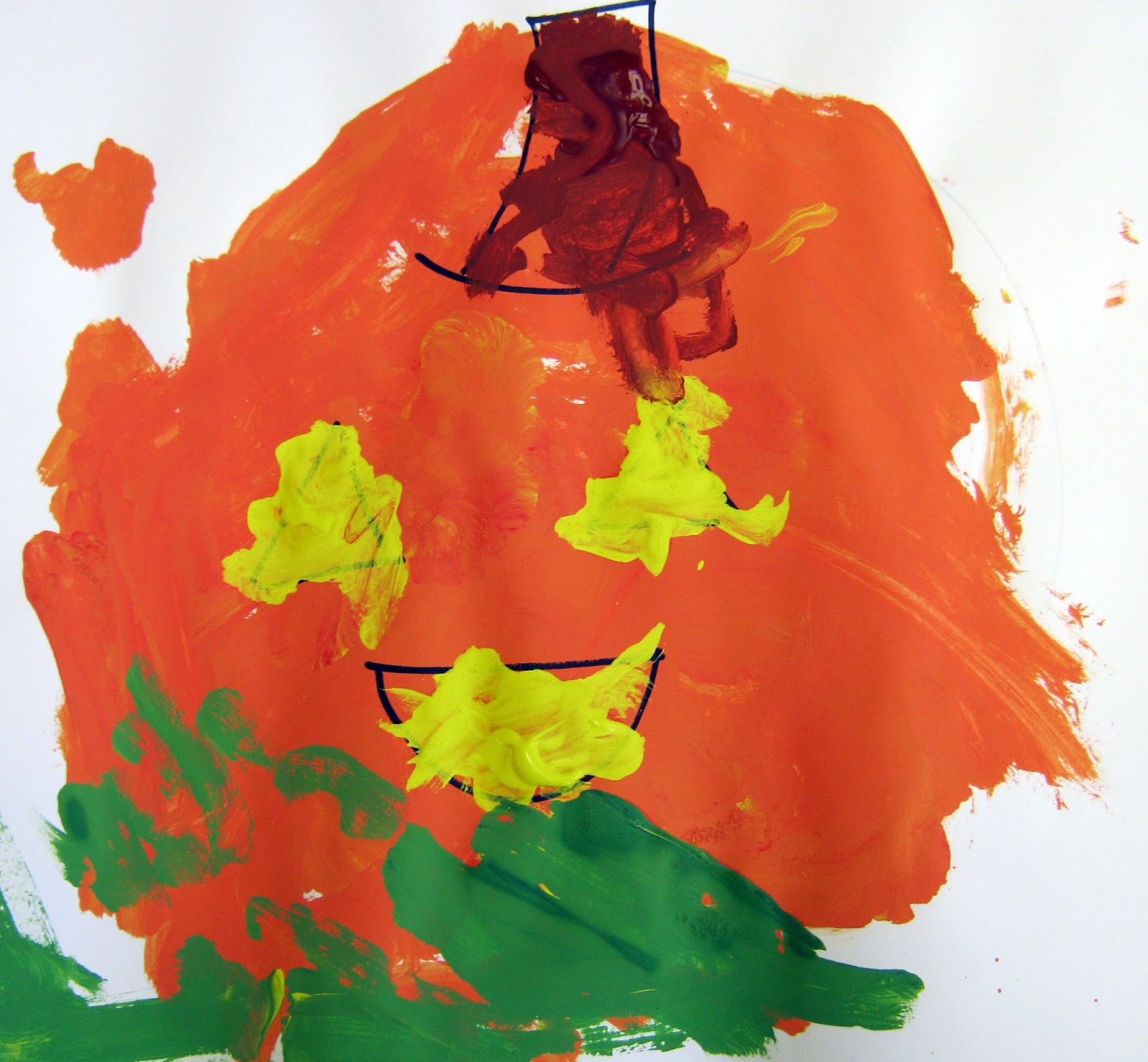
Our 3 year old artists learned the magic of mixing colors in art class! For the month of October we learned how to create the color ORANGE by blending together red and yellow paints.
With our mixed colors, we painted big orange circles on the paper with a paintbrush. These large circles became a Jack-O-Lantern after we added a stem, eyes, and a big smiling mouth.
To create the GREEN grass, we mixed blue and yellow together. This new blended color became the green grass at the bottom of our paintings.
Here are some examples of our finished Jack-O-Lanterns! To see all of our work, click on this link for artsonia and look through our art projects. Happy Halloween everyone! http://www.artsonia.com/schools/school.asp?id=114839
Painting by Marlena
Painting by Odin
Painting by Andrew
Painting by Patrick
Note to families... This art blog will be updated regularly with new posts sharing our daily activities in the art room and news about upcoming art exhibits. To respect the privacy of our students, names will always be limited to first name only and identifiable photos will never be accompanied with a name. If you have any questions or comments, please feel free to write in the comment box below or send me an email at blevine@ranneyschool.org. I would love to hear from you! In my class, students are given the chance to explore different materials and fun new techniques as they develop their signature style. Some young artists love to draw with a pencil, some like to paint on canvas or create images in a digital format, while others prefer working with clay and molding three-dimensional forms. In my classroom, we use a variety of materials allowing all artists to experiment and figure out which type of art they like the best. At Ranney School, we place a strong emphasis on originality and celebrate artistic differences, always nurturing and encouraging the imagination of every student. Remember to check out our display of finished artwork and student portfolios in the Ranney home page of Artsonia.com. http://www.artsonia.com/schools/school.asp?id=114839
Fourth graders are discovering the magic of modern technology in their general art class. With our self portrait project, we are going to explore how art can be expressed using software on the computer. The art of Andy Warhol (1928-1987) is the inspiration for our digital transformations. Andy Warhol saw dramatic changes in the 20th century with factories mass producing products such as Campbell's soup and Coca Cola, and television and movies flashing a constant stream of celebrities, athletes and politicians into our daily lives. His artwork reflected the pop culture of America and he quickly became as famous as the well known people and products he portrayed. Towards the end of his career, he began to see the implication of a digital platform as a creative tool. Imagine what he could have done using the art of Adobe Photoshop!
Adobe Photoshop is a wonderful retouching tool for graphic artists as well as anyone who owns a digital camera or cell phone. Most of us know how to upload photos to a computer and use them in different applications. Therefore, we should also know how to correct a photo, change its size or alter the color. With Photoshop, fourth graders will learn how to do all of that, as well as discover how to change a digital image into a creative and original work of art.
With new advances in technology there is always a moment we have to step back and review what impact this new technology will make in our lives. When I was younger, cameras used film to record images. Unless you were very skilled at darkroom techniques, the image was printed just as it was captured by the camera lens. The best we could do at the time was use a pair of scissors to crop the photo. Now with software such as Adobe Photoshop, photos can be altered and you would never realize a change was made. Photographs can no longer be assumed to reflect real life.
Here is a video by Dove Beauty that I shared with my classes this week. The video really highlights the significance of Photoshop and the impact it has on our perception of beauty and reality.
To prepare for our new "full length" self-portrait project, we practiced drawing a full figure. The wooden artist's model is a perfect way for us to learn how to draw a human figure in proportion. It also shows us where the body can move. Each joint is represented by a wooden ball in the model.
Students began by drawing a sketch of the wooden model, posing their drawing of a figure in any way they wanted. We started with an oval for the head and added a circle underneath for the neck. Each part of the body was added on just this way, a shape for the body part followed by a circle for the place it can move. We were careful to make the length and width of each body part in proportion to the size of the head that we started with. Learning to draw a figure this way reminds us of where the body can move without it looking awkward in our sketches. For example, the arm can move only at the shoulder, elbow or wrist. If we tried to bend it anywhere else, we would be breaking a bone!
Shading each part of the body also gave our figures dimension and form. Here are a few examples of our figures in motion. You can see all of our sketches by following this link to artsonia.com. http://www.artsonia.com/schools/school.asp?id=114839
This week, Kindergarten students completed their self-portraits for the cover of their books, "All About Me!" We practiced drawing circles and then drew a portrait that best represents ourselves. Next week we will begin the illustrations for the inside pages of our books. Drawing our favorite animals, our favorite foods, and pictures of our best friends is a wonderful way to get to know each other in art!
WE ARE ARTISTS IN A MUSEUM!
When Lower School artists finish their projects, as the Kindergartners did with their self-portraits, I photograph everyone's work and upload the images to Artsonia.com, an online art museum for children. Artsonia brings together the artwork of students from many different countries to celebrate creativity in the classroom. All students at Ranney School are automatically a member of this international museum and will be building their own personal portfolios. Families are encouraged to browse the museum and view school exhibitions and student artwork. Students develop a sense of pride as their work becomes published on the site and is viewed by friends and family.
I will be sending home a slip from Artsonia with your child's special registration name and a pass code so that families can register to the site. I look forward to filling these online portfolios with beautiful work all year long!
Here are a few examples of Kindergarten portraits I just uploaded to Artsonia. Check out the Ranney School homepage on Artsonia.com to see everyone's work. http://www.artsonia.com/schools/school.asp?id=114839
Artwork by Claire
Artwork by Elijah
Artwork by Karina
Artwork by Jack
Note to families... This art blog will be updated regularly with new posts sharing our daily activities in the art room and news about upcoming art exhibits. To respect the privacy of our students, names will always be limited to first name only and identifiable photos will never be accompanied with a name. If you have any questions or comments, please feel free to write in the comment box below or send me an email at blevine@ranneyschool.org. I would love to hear from you! In my class, students are given the chance to explore different materials and fun new techniques as they develop their signature style. Some young artists love to draw with a pencil, some like to paint on canvas or create images in a digital format, while others prefer working with clay and molding three-dimensional forms. In my classroom, we use a variety of materials allowing all artists to experiment and figure out which type of art they like the best. At Ranney School, we place a strong emphasis on originality and celebrate artistic differences, always nurturing and encouraging the imagination of every student. Remember to check out our display of finished artwork and student portfolios in the Ranney home page of Artsonia.com. http://www.artsonia.com/schools/school.asp?id=114839
In the inspiring tale, "The Dot," by Peter H. Reynolds, a young art student, Vashti, is afraid to draw on paper because she thinks she is not a good artist. Her teacher suggests that she just make a mark and see where it takes her. This journey of how Vashti discovered her creativity with just a simple dot inspired us to fill Panther Hall gallery with our own unique dots!
Here is a video of "The Dot" . . .
In celebration of this book and the encouraging message it brings to art students, schools all around the world join together in recognition of International Dot Day, September 15th! At our school, students worked together to create dots based on different styles of artwork.
Beginners, Pre-Kindergarten, and Kindergarten artists were were given paper, their favorite colors and a very big brush. We learned how to put on our big blue denim smocks and how to apply paint to paper. We also discovered what happens when we blend different colors together. These painted papers became the circles of our very own "Very Hungry Caterpillar," just like in Eric Carle's illustrations.
First grade artists drew a scene or a design on a square paper, filling all the areas of the paper with soft colors. A circle was then cut out of the center of the square to show the difference between a positive and negative shape.
Second grade artists collaborated to make their project. They each created a random design with bright colors of markers. Their circles were then cut apart into quarter sections and new circles were created out of four different artists' work. How much fun it is for each artist to find their contribution to the new compositions!
Third graders artists learned about the whimsical artwork of Wassily Kandinsky. This Russian artist was very much inspired by the sound and rhythm of music. His famous painting of concentric circles inspired us to create rings of painted colors inside our dots. We experimented with color and patterns and saw how some colors seem to sing out brightly next to other colors.
Fourth grade artists were introduced to abstract artist, Piet Mondrian. Using a white circle for their dot designs, they filled the the circle with a straight, Mondrian-like grid. Students used their design skills with this project, deciding how to turn a simple grid into more of an abstract composition.
Fifth grade artists looked at the assemblages of American artist, Louise Nevelson. She is best known for her large, monotone sculptures. Our dots started as a cardboard circular disc and we glued down all kinds of found objects in wood, foam, paper and metal. These collage discs were then spray painted white to give them the look of Louise Nevelson's work.
Unlike most of our Ranney School art shows, the work on the walls of the gallery for this exhibit is anonymous. (Names are on the back and all art will return home as always!) As we begin our year in art and we are getting to know our new friends, this story by Peter H. Reynolds encourages us to just make a mark and see where it takes us. Our dots represent our working together in unity and support of each other.
There is nothing more exciting to an artist than brand new crayons, sharpened pencils, and a palette filled with bright colors of paint. The art room (rm 205) is upstairs in the Early Childhood Education Center alongside the music room and World Languages. Our special subject hallway is a fun and cheerful place to visit during the Ranney School day.
Welcome to my art room blog!
This blog is our online conversation where you can see highlights of student artwork, videos featuring our young artists, and be updated with news from the art room all year long! You can follow my blog through the email link to the right. I will also send out messages whenever your young artist is honored and celebrated this way. For privacy in the online community, please know that I will not use last names to identify anyone's artwork, and as well, first names will never accompany a recognizable photo. For any questions regarding my use of photography and video in this blog, you are always welcome to stop by the art room or reach out to me at blevine@ranneyschool.org.
As we begin our creative journey this year, students will be given the chance to explore different materials and fun new techniques as they develop their signature style. Some young artists love to draw with a pencil, some like to paint on canvas or create images in a digital format, while others prefer working with clay and molding three-dimensional forms. In my classroom, we use a variety of materials allowing all artists to experiment and figure out which type of art they like the best. At Ranney School, we place a strong emphasis on originality and celebrate artistic differences, always nurturing and encouraging the imagination of every student.
You may also notice that many of our projects are based on the work of a famous artist or illustrator, and that we often look beyond our classroom walls to other cultures for inspiration. Together, we will see how the style of other artists can influence our own creative efforts as well as help us realize and represent our place in the rich world of art history.
Getting ready for the new year
All lower school students, Beginners through 5th grade, should bring in an artist portfolio. If you have one from last year, you are welcome to use it again. Place a new label on the front with the student name and new homeroom teacher. I prefer to have these thin cardboard portfolios for storage in my room, frequently found as a red cardboard portfolio with plastic or woven handles. 17" x 22" or a little larger is perfect. Please do not bring in a very large or a thick leather case. It is only for storage in my room and I will not have the space to hold extra large cases. I look forward to filling these portfolios with wonderful artwork all year long!
5th grade art students should also bring in a sketchpad each week on art days. We will talk about the size and style of sketchpads during our first class. Otherwise, all materials you need for art, including artist's smocks, are already in my room. Come ready to have fun!
Join us in celebration of the class of 2022 as they get ready to cross the lawn in to Middle School art!
Our wall of art in Panther Hall gallery highlights their final painting project for 5th grade and their thoughts on what creativity means to them. Enjoy!