Friday, April 8, 2016

THIRD GRADE . . . The art of the design

Abstract Art: Art that does not attempt to represent reality, but seeks to achieve its effect through shape, line and color.


Abstract by Ava J.


Leonardo da Vinci
Piet Mondrian
Third graders took a journey through art history in the 19th and 20th centuries and saw dramatic changes in what people considered to be "Art." Before the use of a camera, it was an artist's job to make a rendition of any scene or person as realistic and recognizable as possible. An important way to record history was through depictions of portraits and landscapes, paintings of battle scenes or illustrations from the Bible. Leonardo da Vinci's "Mona Lisa" was the level of mastery that artists tried to follow.

During the 19th century, artists explored how they could express their feelings in their artwork and began to break away from the rigid rules of the masters in Europe. Artists who experimented with impressionism or cubism had a difficult time becoming accepted in a traditional art world, but it was their daring ideas that eventually changed the way we view art. Pure abstract art, such as the painting shown above by Piet Mondrian, is not supposed to represent an object or a person. It is meant to stand on its own as a wonderful composition. Learning to appreciate abstract art means understanding and appreciating the art of the design.

Third graders created their own abstract compositions with cut papers. We balanced colors, textures and random shapes together to create a pleasing design. My only rule was that it should not be based on a portrait or a scene, but just a random arrangement of paper.

As well as creating a unique and interesting composition, we played around with which way it should be held. As it is an abstract and not a picture of a person, we showed our collages to the class and turned it four different ways until the students agreed which side should be facing up. Selecting just the right color frame was another important design decision they had to make.

To see all of our abstract collages, follow this link to our 3rd grade exhibit on artsonia.com.
http://www.artsonia.com/schools/school.asp?id=114839


Abstract by Rianna

Abstract by Courtney

Abstract by Giancarlo


Abstract by Peter

Abstract by Julia


Note to families...
This art blog will be updated regularly with new posts sharing our daily activities in the art room and news about upcoming art exhibits. To respect the privacy of our students, names will always be limited to first name only and identifiable photos will never be accompanied with a name. If you have any questions or comments, please feel free to write in the comment box below or send me an email at blevine@ranneyschool.org. I would love to hear from you!
    In my class, students are given the chance to explore different materials and fun new techniques as they develop their signature style. Some young artists love to draw with a pencil, some like to paint on canvas or create images in a digital format, while others prefer working with clay and molding three-dimensional forms. In my classroom, we use a variety of materials allowing all artists to experiment and figure out which type of art they like the best. At Ranney School, we place a strong emphasis on originality and celebrate artistic differences, always nurturing and encouraging the imagination of every student.
     Remember to check out our display of finished artwork and student portfolios in the Ranney home page of Artsonia.com.  http://www.artsonia.com/schools/school.asp?id=114839

Monday, April 4, 2016

SECOND GRADE . . . Spring is here!


Painting by Ryan

Inspired by the artwork of Vincent van Gogh, second graders painted a still life in art class. A still life is an arrangement of everyday objects and by its very definition, the objects are inanimate, not moving, or "still." For our paintings we used a vase with an arrangment of wild flowers. Vincent van Gogh (1853-1890), a Dutch post-impressionist artist, is well known for his painting of "Sunflowers." He painted with short directional brush strokes that helped to define the shape and movement of his compositions.

To explore this style of artwork, we painted our vase, table and back wall with bright colors and added patterns with our brushes all over the page. Then we learned a technique for painting flowers using the thickness of the brush to create the petals. We did not draw our flowers, but went right to paint, letting our brushes create each blossom. They all look like beautiful bouquets of wildflowers! Just like Vincent did with his sunflower still life, we signed our names right on the vase.

Here are some examples of our work. To see all of our 2nd grade flower paintings, click on this link for artsonia.com.  http://www.artsonia.com/schools/school.asp?id=114839

Painting by Dylan 
Painting by Zahra

Painting by William K.

Painting by Savanna

Painting by Jack

Painting by Jonah


Thursday, March 17, 2016

FOURTH GRADE . . . Zen Horses!


Zentangle Horse by Shaya
Fourth graders created these wonderful line drawings of horses in art. With all the busy patterns we used to fill our horses it was important that the silhouette of the animal be recognizable. To draw a realistic outline of a horse, we experimented with a few drawing techniques in class. One technique had us all laughing. We tried to draw a horse without looking at our papers (see next post below). The horses were remarkably accurate and many resemble the quick gesture drawings of Picasso! Then we flipped the horses upside down. This technique sounds strange, but it allowed us to see with the most accuracy. Once our outline was complete we were ready to tackle the small patterns that filled the space.

Our animals are filled with line patterns called Zentangles, a fancy word for a doodle that is formed with repetitive strokes. Zentangles are meant to be a peaceful exercise as the word "zen" implies. Once you decide to draw a certain type of line or a swirl, you simply repeat it a few times. You do not have to constantly make new decisions, just enjoy the art of repeating the lines you draw and the overall pattern they create.


Zentangles could be considered a modern form of doodling, but detailed line patterns can be traced back in time to the decorative artwork of ancient cultures.

During the Medieval age, designs like these were used in manuscript illuminations, such as seen on the pages of the Book of Kells, an illuminated Gospel book written in Latin.


Here are some of our beautiful Zentangle horses for you to marvel at! To see all of our work, click on this link for artsonia.com. http://www.artsonia.com/schools/school.asp?id=114839

Zentangle Horse by Maggie

Zentangle Horse by Starlette

Zentangle Horse by Balkan

Zentangle Horse by Gabrielle

Zentangle Horse by Hunter


FOURTH GRADE . . . Drawing upside down and without looking!

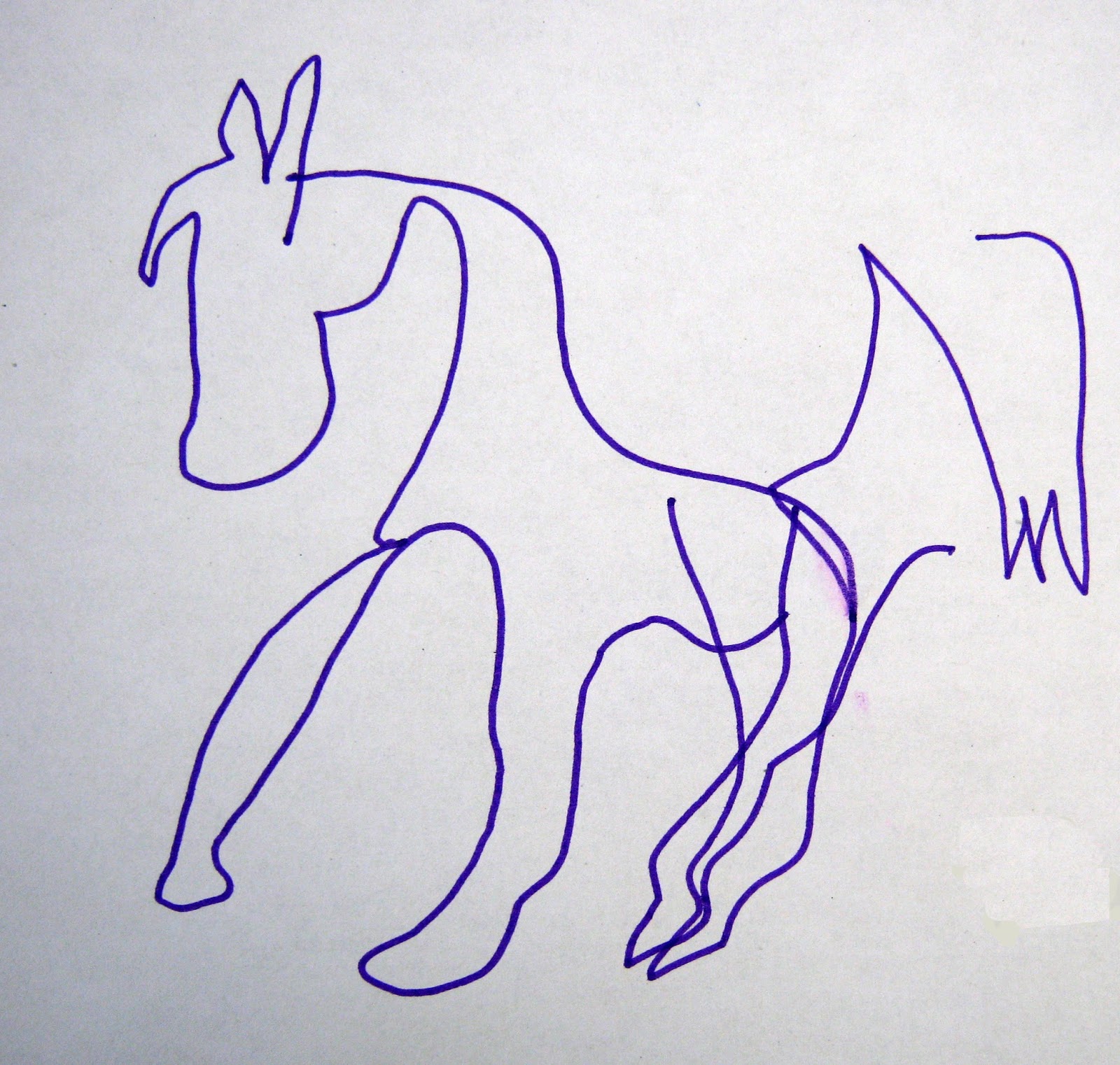
Blind contour drawing by  Maddie

Fourth graders were asked to draw an outline of a horse. To get the outline of the animal drawn accurately, we tried out a couple of fun artist tricks. Can you tell that Maddie's drawing is a horse? Not only can we see the animal, but it looks like it is full of movement!

Blind Contour drawing by Nico

Blind Contour drawing by Mason
To do these blind contour drawings, we never looked at our drawing papers. We were given a marker--not a pencil--since there was no need to erase and correct something that we could not see. A silhouette of the horse was projected on the board and we used our eyes to travel around the animal, taking in all the curves and angles of the outline. The marker recorded on paper the journey that our eyes were taking around the animal. If these were done correctly, (without peeking!) the beginning of our line would not line up with the end as we cannot see where we started.


Another strange exercise we tried was to draw our horses upside down. Why would an artist want to draw upside down? I did not suggest that we stand on our heads . . . but to draw an image that is turned around. It is a challenge to see all the fine details of an image correctly. Drawing this way can trick your eyes into observing more of the details of the picture.

When you look at a picture of a horse the regular way, your mind invariably takes over as you are drawing and you tend to draw what you remember how a horse looks, not as shown in the picture in front of you. The image of the horse in your mind probably has an four thin legs as all horses do. But are you really seeing those legs as they appear in the picture, with all the angles and the lines?

Now look at this upside down picture of a horse. By turning the image around, we transform the horse into a random picture filled with angles and shapes. It is much easier to notice how to draw the legs this way. Even the negative space in between the legs is easier to see and helps us place the legs in the right position and with the correct angles.


These exercises were challenging for us to do. The more we trick our minds into seeing the world in a different way, the more we can observe the world through the eyes of an artist.

Tuesday, March 8, 2016

WINTER ART CLUB !

Painting by Elle B., 3rd grade
After school clubs at Ranney School offer many different fun activities for our Lower School students to enjoy. All year, LS artists can sign up for the art club, and with our winter session we focused on painting. Students in my club were welcome to choose any subject to paint. Many picked a realistic image such as Elle's amazing fox, and others wanted to work in more of a cartoon style or a graphic image. Ava was even inspired by Vincent van Gogh and painted her own version of Starry Night!

Some of my artists are still working to complete their canvases, but those not photographed here will still get to share their work with everyone in our spring art show later in the school year.

This is what we painted this winter . . .

Painting by Santino C., 3rd grade

Painting by Ava A., 2nd grade

Painting by Isabella P., 3rd grade

Painting by Brandon S., 5th grade

Painting by Caitlyn C., 3rd grade

Painting by Giancarlo C., 3rd grade

Painting by Marcella L., 3rd grade

Painting by Sabrina L., 3rd grade

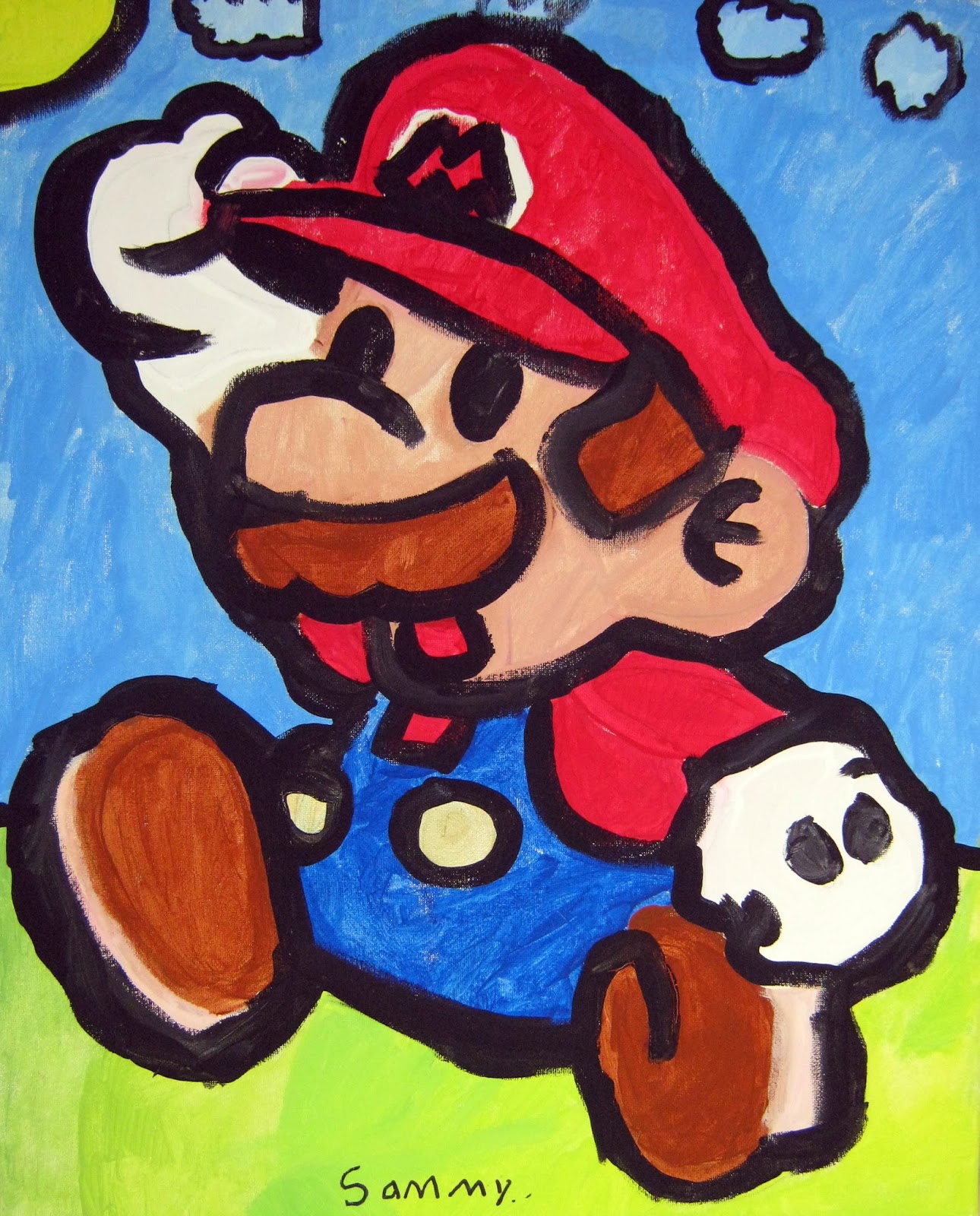
Painting by Sammy L., 2nd grade

Painting by Tyge F., 5th grade

Painting by Savanna S., 2nd grade


Wednesday, March 2, 2016

KINDERGARTEN . . . Dr. Seuss!

 Drawing by Michaela
Drawing by Ally


To celebrate Dr. Seuss' birthday on March 2, Kindergarteners drew a picture of a very familiar friend of theirs . . . a cat in a tall, striped hat! "The Cat in the Hat" is one of 44 books illustrated and written by Theodor Seuss Geisel (1904-1991), better known to all of us as the beloved Dr. Seuss.

Kindergarteners celebrated the day by walking to art today with the tall striped hats they made in their homeroom classes. Some wore red in honor of the Cat in the Hat and we were all given extra reading time today too!

Look at this wonderful sculpture made out of Legos of the famous cat!


Here are some more of our drawings. To see all of our work, click on this link for artsonia. com and scroll down to the Kindergarten exhibit.  http://www.artsonia.com/schools/school.asp?id=114839

Drawing by Ava
Drawing by Claire

Drawing by Noah

Drawing by Timmy


Monday, February 29, 2016

SECOND GRADE . . . A Ranney Landscape

Landscape by Dylan
Second graders created landscapes of Ranney School. Can you recognize some of the buildings in Dylan's illustration? Using creative choices for his colors, he drew the Barn Building (the ECEC), the Lower School building, the Clock Tower and the Little White House! A large sign welcomes everyone to his scene.

Inspired by the artwork of Norman Rockwell (1894-1978), we saw how the amazing details of Rockwell's scenes helps to capture our interest and tells us a story about life in 20th century America. The image below is a street scene of Stockbridge, Massachusetts, the town where he lived. Norman Rockwell not only included the buildings on Main Street in Stockbridge, but he filled his painting with people and cars passing by to give us a feeling of life in the town. We can also tell it takes place during December by the Christmas decorations on the buildings, the bare trees outside, and the snow on the ground.


To create our landscapes, we looked carefully at the architectural details of the buildings on our campus. For the most part, the buildings all start off as a rectangle and many of them have a triangular roof just over the front door. Adding special details, such as the windows, the columns, a flag, a winter tree, a sign, and kids playing outside, help to tell our story of Ranney School. Here are some more wonderful examples of our landscapes! To see all of our work, follow this link to our exhibit page on artsonia.com.   http://www.artsonia.com/schools/school.asp?id=114839


Landscape by Alexander

Landscape by Mara

Landscape by Tori

Landscape by Sammy
Note to families...
This art blog will be updated regularly with new posts sharing our daily activities in the art room and news about upcoming art exhibits. To respect the privacy of our students, names will always be limited to first name only and identifiable photos will never be accompanied with a name. If you have any questions or comments, please feel free to write in the comment box below or send me an email at blevine@ranneyschool.org. I would love to hear from you!
    In my class, students are given the chance to explore different materials and fun new techniques as they develop their signature style. Some young artists love to draw with a pencil, some like to paint on canvas or create images in a digital format, while others prefer working with clay and molding three-dimensional forms. In my classroom, we use a variety of materials allowing all artists to experiment and figure out which type of art they like the best. At Ranney School, we place a strong emphasis on originality and celebrate artistic differences, always nurturing and encouraging the imagination of every student.
     Remember to check out our display of finished artwork and student portfolios in the Ranney home page of Artsonia.com.  http://www.artsonia.com/schools/school.asp?id=114839