Tuesday, May 12, 2015

FIFTH GRADE . . . Learning about Picasso

Abstract Sculpture by Alexis

Fifth graders experienced abstract art with our latest sculpture project. Inspired by the shapes and forms of our favorite musical instruments, we built an abstract version of our instruments using wood, string and cardboard.

Pablo Picasso changed the way we all view and accept what we consider to be "Art." His brilliant and influential ideas went far beyond just painting a face with features in the wrong place. As a well trained realistic artist, he could create a very recognizable and beautiful study of the human face. He was trained in anatomy and in figure drawing. He understood how to represent the world on paper in a traditional way. Why would an artist paint a face as strangely abstract as he is best known for doing, if he could draw like this image below?

Realistic Sketch by Picasso
Abstract painting by Picasso
Fifth graders compared these two images in class and most students thought he was just having fun with the shapes and colors, or he was looking for a way to be different. We looked at the events and developments at the end of the 19th century that might have led to an acceptance of abstract art as an art form. Architecture with the design of the Eiffel Tower, for example, also displayed this new obsession with an abstract visual that went beyond practicality. The world was changing and Pablo Picasso was a dramatic leader in our changing vision. His cubist portrait with features drawn in strange places was a creative experiment in how to portray a 3D person on a flat surface. Why would you try to make something look like it has dimension on a flat canvas, if the surface is flat? He broke all the rules as he tried to make sense out of these revolutionary ideas.

Picasso's Guitars
Music was a recurring theme for Picasso and many other abstract artists of his time. A few years back, the MoMA in NYC held a show of Picasso's guitars. These pieces were collages and reconstructed musical instruments reflecting his ideas with cubism and abstractions. We used this collection of pieces by Picasso as the inspiration for our fifth grade art show.

Just as Picasso was trained early in his life as a realistic artist, we began with realistic sketches in our sketch pad of our instruments. Then we looked for creative ways to break all the rules and create a sculpture inspired by music, without trying to reproduce our instruments in a realistic way.

Here are a few examples of our work. To see everyone's sketches and sculptures, follow this link to the Ranney School exhibit page on artsonia.com.    http://www.artsonia.com/schools/school.asp?id=114839


Sketch by Lily
Abstract Sculpture by Lily

Sketch by Tucker
Abstract Sculpture by Tucker

Sketch by Emily
Abstract Sculpture by Emily

Sketch by Oscar
Abstract Sculpture by Oscar

Sketch by Sophia Z.
Abstract Sculpture by Sophia Z.


Monday, May 11, 2015

KINDERGARTEN . . . and then what happened?

Did you ever read a story, close the book, and wonder what happened next? Did the characters in the book just live happily ever after or did you wish there were more adventures to read about?

Kindergarteners shared a story as told by Aesop, over 2000 years ago in Greece. Aesop's Fables, a collection of stories featuring animals as the lead characters, teaches us lessons about human life. In the fable, "The Lion and the Mouse," Aesop entertains us with the idea that a small mouse might be able to save a ferocious lion from the trap of hunters. The moral of this story is; "Even the strongest can sometimes use the help of the smallest." 

In our illustrations of this fable, Kindergarteners continued the story that began so many years ago. What happened after the mouse helped the lion? Could they become friends? Here are a few adventures to enjoy...

Artwork by Brooke

Artwork by Cash

Artwork by Mia G.

Artwork by Sydney

Friday, May 1, 2015

FIRST GRADE . . . Who invented art anyway?


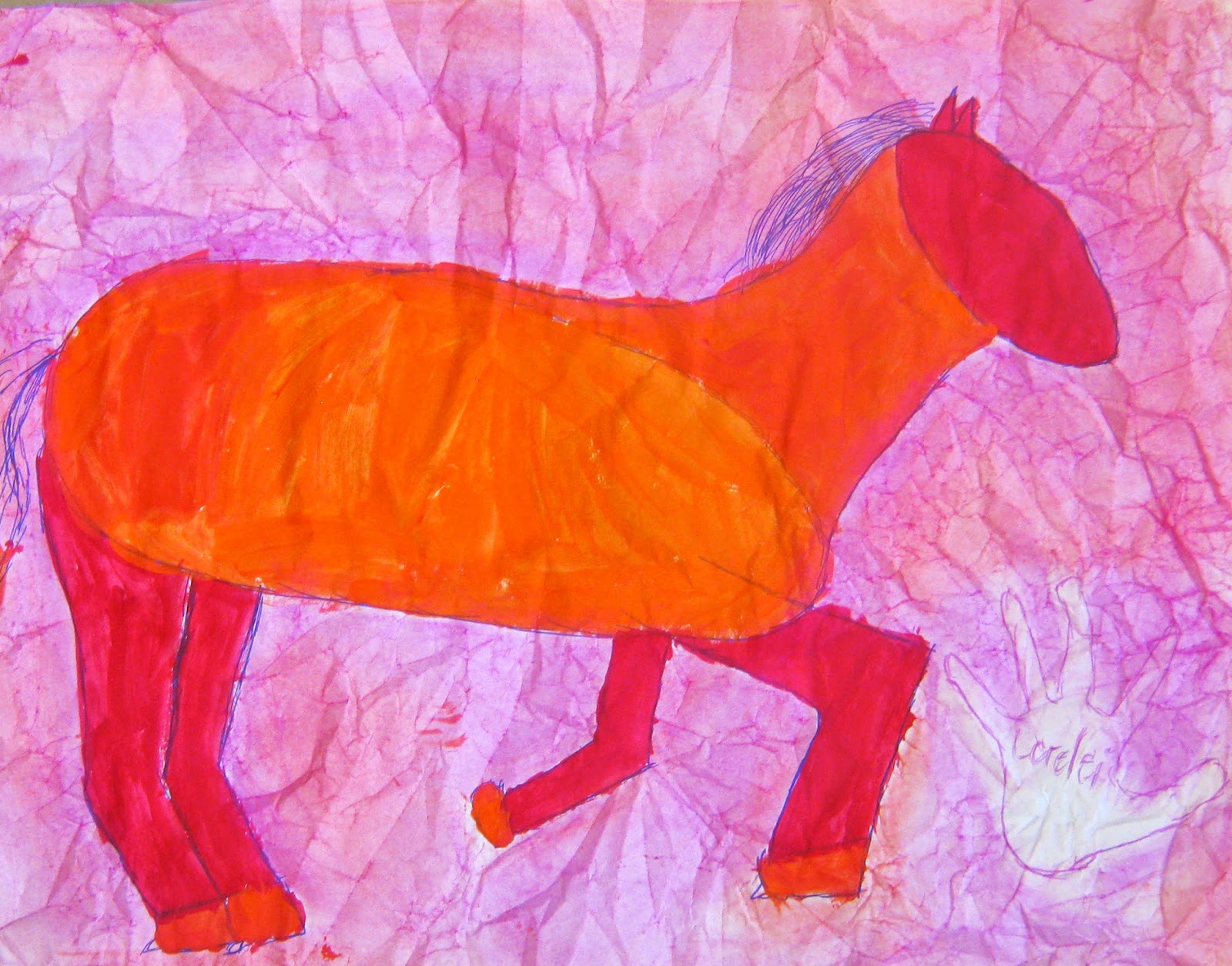
First graders took a trip back in time, over 40,000 years ago, to the age of cave people. Cavemen drew amazingly realistic pictures of animals on the walls of caves. What kinds of art tools do you think they used? Was there a Michael's Arts and Crafts back then to buy paints and brushes?

We looked at cave paintings of early horses, buffalo and other animals. They were not only recognizable, they looked like they were drawn in action, appearing as if they were running on the walls in the caves! Surprisingly, these images of early cave art are very similar all over the world, which suggests that people were producing "art" at a much earlier time, possibly before they began to spread out across the earth.

In art class, we drew our animals in pencil and marker on big sheets of recycled paper. Then we crinkled up the drawings to create creases, just like on the surface of a rock. The animals were painted in warm earth tones, and chalk was rubbed into the background areas to represent the marks and colors of the wall.

Often, the cavemen used a hand print to signify people in their art. Taking a cue from the images we shared in class, we traced our hands near our animals to represent our signatures.

Here are a few examples of the work in our prehistoric cave. All of our paintings will be on display in Panther Hall next week for our Spring art show. You can also see everyone's images on artsonia.com.   http://www.artsonia.com/schools/school.asp?id=114839

Cave Painting by Adam
Cave Painting by Saahil

Cave Painting by Lorelei

Cave Painting by Zahra


Thursday, April 30, 2015

THIRD GRADE . . . design and composition

Abstract Art: Art that does not attempt to represent reality, but seeks to achieve its effect through shape, line and color.


Abstract Collage by Nico

Leonardo da Vinci
Piet Mondrian
Third graders took a journey through art history in the 19th and 20th centuries and saw dramatic changes in what people considered to be "Art." Before the use of a camera, it was an artist's job to make a rendition of any scene or person as realistic and recognizable as possible. An important way to record history was through depictions of portraits, landscapes, paintings of battle scenes or illustrations from the Bible. Leonardo da Vinci's "Mona Lisa" was the level of mastery that artists tried to follow.

During the 19th century, artists explored how they could express their feelings in their artwork and began to break away from the rigid rules of the masters in Europe. Artists who experimented with impressionism or cubism had a difficult time becoming accepted in a traditional art world, but it was their daring ideas that eventually changed the way we view art. Pure abstract art, such as the painting shown above by Piet Mondrian, is not supposed to represent an object or a person. It is meant to stand on its own as a wonderful composition. Learning to appreciate abstract art means understanding and appreciating the art of the design.

Third graders created their own abstract compositions with cut papers. We balanced colors, textures and random shapes together to create a pleasing design. My only rule was that it should not be based on a portrait or a scene, but just a random arrangement of paper.

As well as creating a unique and interesting composition, we played around with which way it should be held. As it is an abstract and not a picture of a person, we showed our collages to the class and turned it four different ways until the students agreed which side should be facing up. Selecting just the right color frame was another important design decision they had to make.

To see all of our abstract collages, follow this link to our 3rd grade exhibit on artsonia.com.
http://www.artsonia.com/schools/school.asp?id=114839

Collage by Kaitlyn
Collage by Gabriella

Collage by Luke


Collage by Seth


Note to families...
This art blog will be updated regularly with new posts sharing our daily activities in the art room and news about upcoming art exhibits. To respect the privacy of our students, names will always be limited to first name only and identifiable photos will never be accompanied with a name. If you have any questions or comments, please feel free to write in the comment box below or send me an email at blevine@ranneyschool.org. I would love to hear from you!
    In my class, students are given the chance to explore different materials and fun new techniques as they develop their signature style. Some young artists love to draw with a pencil, some like to paint on canvas or create images in a digital format, while others prefer working with clay and molding three-dimensional forms. In my classroom, we use a variety of materials allowing all artists to experiment and figure out which type of art they like the best. At Ranney School, we place a strong emphasis on originality and celebrate artistic differences, always nurturing and encouraging the imagination of every student.
     Remember to check out our display of finished artwork and student portfolios in the Ranney home page of Artsonia.com.  http://www.artsonia.com/schools/school.asp?id=114839

Wednesday, April 15, 2015

SECOND GRADE . . . Spring has arrived!

Inspired by the artwork of Vincent van Gogh, second graders painted a still life in art class with a vase and a bouquet of flowers. Vincent van Gogh (1853-1890), a Dutch post-impressionist artist, created many paintings of a vase with flowers. Most people are familiar with his arrangement of "Sunflowers." Van Gogh was known for using short directional brush strokes to help to define the shape of his objects and the movement in his scenes.

"Sunflowers"
Vincent van Gogh

We set out to explore van Gogh's style of artwork. We painted our vase, table and back wall with bright colors, adding patterns with our brush strokes. Some of the designs are very subtle, such as in Bianca's lovely painting below. Some students chose to create a more abstract design and this keeps our eyes moving all over the page, such as with Cole's masterpiece. Other students added more dramatic patterns, such as Sabrina's painted swirls that beautifully frame her bouquet of flowers. The different styles of our paintings reflect our own creative expression.


Once our backgrounds and vases were completed, we learned a new technique for painting flowers. We did not draw our flower petals with a pencil, but let the thickness of our brushes to do all the work, This gave our blossoms a more natural appearance, as if they were 'just picked' wildflowers. Everyone used the same technique, but notice how different each bouquet and each flower within the bouquets appear.

Finally, just as Vincent signed his painting on the vase, we signed our names the same way. Here are more examples of our work. To see all of our 2nd grade flowers in bloom, click on this link for artsonia.com.  http://www.artsonia.com/schools/school.asp?id=114839


Tuesday, April 7, 2015

GRAPHIC ARTS . . . Stepping into a painting!

Part of the magic of Adobe Photoshop is the ability to merge two images together and make it look like one image. Back in the day before computers, to remove part of a photograph we simply cut the photo with a pair of scissors. To attach one photo to another, we used glue or tape. But, today, with computer technology, we can now remove any part of a digital photograph, and place it over another image, joining the two seamlessly.

Lower School graphic artists learned how to merge images just that way with this project. Each artist selected a famous painting and then posed for a picture that would make sense if they became part of the painting.

To merge the two images together, students first opened their famous painting in Adobe Photoshop. This image became the background for the project. Next, we opened and selected the posed photograph. By copying the photo and pasting it over the painting, we created a new layer. Separate layers help us alter parts of one image without changing the other layers. We learned how to use a lasso tool and the eraser tool to remove the background from the posed photo, revealing the painting underneath. Using other tools, such as the opacity scale and the free transform editing mode, we were able to adjust the size, rotation and position of the photo to align with the painting. Using even more advanced tools, such as artistic filters, we could make the images match in appearance perfectly.

Here are a few examples of our graphic artists stepping into a painting!


Monday, April 6, 2015

GRAPHIC ARTS . . . In "Love" with word sculptures!


In 1964, American artist, Robert Indiana, designed this Love design for the Museum of Modern Art as their Christmas card. The iconic image shows the four letters of the work LOVE stacked together with the letter "O" at a tilt. This same design became an image for a US postage stamp and then as a sculpture in 1970. His sculpted word designs are now on display all over the world. Fascinated with letters and numbers, Robert Indiana is a self-proclaimed "American painter of signs."

As graphic artists, we often look at letters and numbers as an important feature of any design. Each lower school graphic artist selected a four letter word, such as LOVE, that they identified with. Using Adobe Illustrator, we learned how to work with shapes, colors and text to create a colorful design with our words.

Just as Indiana transformed his flat design into sculpted art, we then used the tools in Adobe Illustrator to play around with 3-Dimensional images of our flat designs. In this digital transformation, we learned how to make objects move forward and back in their orientation, so that each part of our 3D design looks like it is supported by the forms underneath. Here are a few wonderful examples of our work...


"COOL"
Designed by Christopher


"FIFI"
Designed by Fiona


"FINN"
Designed by Alexa