Wednesday, February 4, 2015

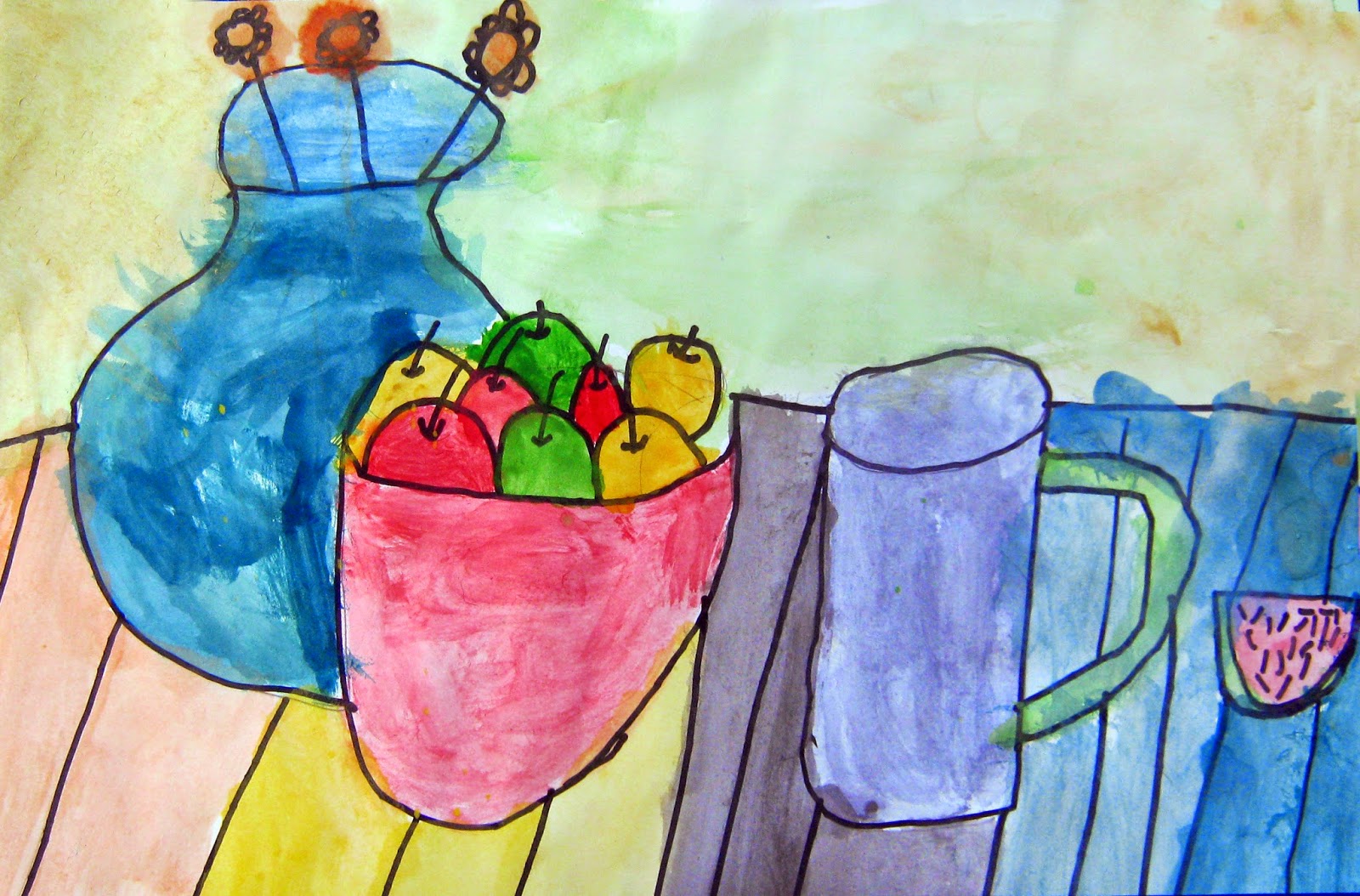
SECOND GRADE . . . The arrangement of a still life

Paul Cezanne (1839-1906) is a famous Post Impressionist artist from France. He often focused on the arrangements in a still life as his choice of subject matter. Cezanne studied the shapes and angles of his arrangements to create a dynamic composition. Can you see any shapes in this painting, "Apples and Oranges," by Paul Cezanne? His work influenced artists such as Pablo Picasso and he was considered by many to be the father of modern art.
     The composition of a still life is the most important thing to consider. Objects are arranged on a table top to create interest, to highlight color, and to create a sense of movement across the page. When we began our still life drawings, we learned how to create a composition with overlapping shapes. When objects overlap, it is important to understand which one goes in front. We learned that the object or figure lowest on the page should be the one in the front.


Every round object we created began with a circle or an oval. The top of a vase or a bowl looks like a circle when you look straight down at the object, but when it is place on an table and you see it from a distance, the top circle appears more as an oval. Even the bottom line of the vase appears to have the same curve as the oval at the top. Understanding how to represent a round object on paper helps us to better see the form.


Once we drew all our objects in an interesting overlapping arrangement and added in details, such as fruit, a table cloth and a background, we used watercolors and a fine detail brush to add color.

Here are a few wonderful examples of our still life paintings. You can see everyone's work by following this link to artsonia.com.
http://www.artsonia.com/schools/school.asp?id=114839

Artwork by Layla
Artwork by Ethan S.

Artwork by Lynna

Artwork by Anthony


Note to families . . .
    This art blog will be updated regularly with new posts sharing our daily activities in the art room and news about upcoming art exhibits. To respect the privacy of our students, names will always be limited to first name only and identifiable photos will never be accompanied with a name. If you have any questions or comments, please feel free to write in the comment box below or send me an email at blevine@ranneyschool.org. I would love to hear from you!
    In my class, students are given the chance to explore different materials and fun new techniques as they develop their signature style. Some young artists love to draw with a pencil, some like to paint on canvas or create images in a digital format, while others prefer working with clay and molding three-dimensional forms. In my classroom, we use a variety of materials allowing all artists to experiment and figure out which type of art they like the best. At Ranney School, we place a strong emphasis on originality and celebrate artistic differences, always nurturing and encouraging the imagination of every student.
     Remember to check out our display of finished artwork and student portfolios in the Ranney home page of Artsonia.com.  http://www.artsonia.com/schools/school.asp?id=114839

Tuesday, February 3, 2015

FOURTH GRADE... Creating a Mandala with the letters of our names!


Fourth graders created a colorful circle design based on the art of the Mandala. Our designs were created out of the letters of our names. The repetition of colors and shapes around the circle are all created out of letters and the spaces between the lettering.

The word, "Mandala," is from the classical Indian language of Sanskrit. Loosely translated, it means "circle." It represents wholeness and appears in all aspects of life: the celestial circles we call the earth, sun and moon, as well as the conceptual circles of friends, family and community.

In ancient Tibet, as part of a spiritual practice, intricate mandalas were created out of colored sand and crushed stones. The designs in a mandala repeat as they rotate around the circle and any symbols used in the design must be perfectly reproduced each time within the circle. Rowan J. in one of our fourth grade classes recognized one of the symbols used in this mandala. He said it is the symbol "ar" that is used for Tibetan meditation. How wonderful that we can learn about so many different cultures right in our own classroom. Thank you Rowan!

The American Navajo also created sand paintings used in spiritual rituals, much the same way as they are used by the Tibetans. These designs could range in size from 3-15 feet but only last about a week, depending on the weather and wind conditions.

To create our mandalas, we started with a shape that looks like a slice of pie. It is 1/6th of the full circle. In this shape, we drew the letters of our name either in bubble letters or with straight lines. Then we used a light box in my room to trace our single name design into the full circle, repeating the letters as they rotate around the circle. Just as we did with our last project, we also used a mirror image repetition to make it reflect and add symmetry to the design.

Here are some examples of our name mandalas. Can you find the names hidden in these designs? Some of the students shortened their names or used a nickname for their design. To see all of our mandalas, click on this link for Artsonia and scroll down to the fourth grade exhibit.
http://www.artsonia.com/schools/school.asp?id=114839

Artwork by Nehemiah (Neo)
Artwork by Ava

Artwork by Charlie (Chuck)
Artwork by Colette (CeCe)

Monday, December 15, 2014

The Kindergartener who Painted a Blue Horse

Many of our students in Kindergarten are familiar with the illustrations and stories of Eric Carle books. “The Very Hungry Caterpillar” and “Brown Bear, Brown Bear, What do you See?” are two examples of his popular stories. Eric Carle’s “The Artist who Painted a Blue Horse,” is the book we used as the inspiration for our latest project.

To make our collages, Kindergarten students painted a large piece of paper with two colors close to each other on the color wheel, such as red and orange, or blue and green. We used a very large brush and created designs with the brush strokes. When the paint dried, students traced and cut the shape of their favorite animal out of the paper.

To complete the project, we created a background for the animals on a separate piece of paper with a much smaller brush. The animals were then glued down over this background scene.  As we are learning with each of our projects in art class, our pictures can tell a story. We might have used Eric Carle's illustrations to inspire our artwork, but as you can see with this video, we each have a story to tell as well.

This video includes the all of the Kindergarten students of Ranney School. Make sure your sound is turned on to hear our voices. Enjoy!


Monday, November 24, 2014

FIFTH GRADE . . . Drawing on the iPad!

Artwork by Alexa 
Artwork by Christopher
Artwork by Kayla

Artwork by Anthony


Our 5th grade self-portraits this year are digital portraits! We used an app on the iPad called, Sketchbook Pro. This app allows us to work from a photograph and to work in layers. In the tools palette of the app you are able to select from a pencil, pen, paintbrush, airbrush, eraser, chisel marker and many other art tools. In addition, you are able to choose the weight of line, the opacity of the color and work in colors from a variety of different palettes. The choice of how you draw and what you can create is endless!

David Hockney
iPad Illustration for the New Yorker
David Hockney is a famous present day artist from England, well known for his bold and colorful canvases. Mr. Hockney has also become known for his digital artwork as well, using drawing apps and creating illustrations for the cover of the New Yorker Magazine. Creating art on a tablet or phone is no longer just a game or a way to pass the time, it is used by many artists as their modern day sketchpad and can be considered a serious art form that reflects our time.

Here is a quote by David Hockney...
“People from the village come up and tease me: ‘We hear you’ve started drawing on your telephone,’” Mr. Hockney said in a quotation displayed in the exhibition. “And I tell them, ‘Well, no, actually, it’s just that occasionally I speak on my sketch pad.’”


When we drew our portraits, we worked in layers. One layer was our drawing layer, using a thin black line. The next layer was our color layer and we could choose from many colors in a variety of color palettes, as well as pick up a color directly from the photograph. The final layer was created for the background design and that layer sits behind everything else. To see all of the portraits that have been completed, check out our exhibition page on Artsonia.com.
http://www.artsonia.com/schools/school.asp?id=114839


Note to families...
This art blog will be updated regularly with new posts sharing our daily activities in the art room and news about upcoming art exhibits. To respect the privacy of our students, names will always be limited to first name only and identifiable photos will never be accompanied with a name. If you have any questions or comments, please feel free to write in the comment box below or send me an email at blevine@ranneyschool.org. I would love to hear from you!
    In my class, students are given the chance to explore different materials and fun new techniques as they develop their signature style. Some young artists love to draw with a pencil, some like to paint on canvas or create images in a digital format, while others prefer working with clay and molding three-dimensional forms. In my classroom, we use a variety of materials allowing all artists to experiment and figure out which type of art they like the best. At Ranney School, we place a strong emphasis on originality and celebrate artistic differences, always nurturing and encouraging the imagination of every student.
     Remember to check out our display of finished artwork and student portfolios in the Ranney home page of Artsonia.com.  http://www.artsonia.com/schools/school.asp?id=114839

Tuesday, November 18, 2014

KINDERGARTEN . . . We are Authors and Illustrators!


We have finished our books called, "All About Me !" Our self portraits became the cover of the book and we filled the pages with our favorite things. Here are a few sample pages from our Kindergarten books. With each illustration, we learned about shapes, lines, color, and how to represent what we like best through our artwork. These books will be going home for Grandparents and Friends' Day!

Illustration and words by Claire
Illustration and words by Alexandra
Illustration and words by Vincent
Illustration and words by Ansh


Note to families...
This art blog will be updated regularly with new posts sharing our daily activities in the art room and news about upcoming art exhibits. To respect the privacy of our students, names will always be limited to first name only and identifiable photos will never be accompanied with a name. If you have any questions or comments, please feel free to write in the comment box below or send me an email at blevine@ranneyschool.org. I would love to hear from you!
    In my class, students are given the chance to explore different materials and fun new techniques as they develop their signature style. Some young artists love to draw with a pencil, some like to paint on canvas or create images in a digital format, while others prefer working with clay and molding three-dimensional forms. In my classroom, we use a variety of materials allowing all artists to experiment and figure out which type of art they like the best. At Ranney School, we place a strong emphasis on originality and celebrate artistic differences, always nurturing and encouraging the imagination of every student.
     Remember to check out our display of finished artwork and student portfolios in the Ranney home page of Artsonia.com.  http://www.artsonia.com/schools/school.asp?id=114839

Monday, November 17, 2014

FIRST GRADE . . . Weaving with patterns

First Graders are learning to weave in art class. This is a project that celebrates the art and culture of the Native Americans and teaches us a wonderful technique using patterns.

Our handmade looms were created out of the cardboard base from water bottle trays and we recycle these looms every year. Six slits are cut into both ends of the cardboard and yarn is strung from top to bottom creating the warp (or vertical) strings of the loom.

Next students choose their first color to weave with. We learned how to measure the yarn against a table edge by working in pairs with our friends. One student holds the end of the yarn against the end of the table and the other student unrolls the yarn to match the length of the table and cuts it off. To weave our colored yarn into the loom threads, we learned how to follow a pattern of "Over, Under, Over, Under, Over and Under." Not only is the process of weaving a pattern, but we can also create a pattern by alternating our colors of yarn.

Here is a short video of some of our students demonstrating how to measure the yarn and weave!


Tuesday, November 11, 2014

LOWER SCHOOL ART EXHIBITION


Lower School art exhibition is now on display in Panther Hall Gallery. Still be to exhibited are the Fifth Grade digital self portraits. As students are finished with their projects, they will be added to the gallery. I hope to see all of our families and friends come out to see our show for Grandparents and Friends day. 
Happy Thanksgiving everyone!

Friday, November 7, 2014

THIRD GRADE... Adding details to our paintings

Artwork by Alexandra
Artwork by Christopher
Artwork by John  W.
Third graders added details to complete their portrait paintings. We blocked in the main colors of the portraits last week, leaving us to work on the hair, the features of our faces and any other small detail designs we wanted to add.

Just like with our skin tones, we tried to match our hair color to best represent us in the portrait. With a wide brush we painted the hair in the same direction our hair grows, treating the paint brush as we would a hair brush. With a smaller detail brush we added eyebrows to match the hair color.

Detail of Eyes
Artwork by Carter
For our eyes, we painted just the center circle of the drawn eye with blue, brown or hazel. Then using the smallest brush possible, we added the black circle of the pupil, a white dot for the highlight in the eye, and a very thin line to create the upper lid, indicating the line of the lashes. This is how famous impressionist artist, Pierre-Auguste Renior, painted eyes in his portraits. Simple and soft, but very realistic looking.

We finished up our portraits with a lip color and added other details to make our portraits special and uniquely ours. Please log onto Artsonia, an online museum that Ranney School participates in and see all of our 3rd grade portraits. If you have not already registered to the site, a note will be coming home soon with all the necessary information granting you access to your child's online portfolio.  http://www.artsonia.com/schools/school.asp?id=114839

Note to families...
This art blog will be updated regularly with new posts sharing our daily activities in the art room and news about upcoming art exhibits. To respect the privacy of our students, names will always be limited to first name only and identifiable photos will never be accompanied with a name. If you have any questions or comments, please feel free to write in the comment box below or send me an email at blevine@ranneyschool.org. I would love to hear from you!
    In my class, students are given the chance to explore different materials and fun new techniques as they develop their signature style. Some young artists love to draw with a pencil, some like to paint on canvas or create images in a digital format, while others prefer working with clay and molding three-dimensional forms. In my classroom, we use a variety of materials allowing all artists to experiment and figure out which type of art they like the best. At Ranney School, we place a strong emphasis on originality and celebrate artistic differences, always nurturing and encouraging the imagination of every student.
     Remember to check out our display of finished artwork and student portfolios in the Ranney home page of Artsonia.com.  http://www.artsonia.com/schools/school.asp?id=114839

Thursday, November 6, 2014

FOURTH GRADE . . . modern technology meets traditional art


Our self portraits began as a lesson in technology when we learned how to use Adobe Photoshop in our art class. Then we turned back the clock to the 16th century and learned about the life and work of Leonardo da Vinci. Inspired by his mirror image writing, we retouched our photos on the computer and then created a mirror image drawing of one half of the photograph.

It was not possible to upload these drawings to Artsonia because they contain photographic images. Therefore, in order to share our drawings with you, I have created an iMovie with everyone's final work. Press the play button on the video below to enjoy our smiling faces and wonderful artwork!

Wednesday, November 5, 2014

SECOND GRADE . . . A Pop of color!


Artwork by Isabella
Artwork by Alexander
Second Graders finished their colorful Pop Art Portraits this week. We used different colors for each background and varied the colors for our hair, shirt and small designs. Choosing different colors for each of the four portraits imitates the style of Andy Warhol's popular silkscreen art during the 20th century.


Artwork by Gwendolen
Artwork by Gavin
It was fun to see how we would look with red hair, with black hair, or even with gray hair! By adjusting the color palette for each of our portraits, we learned how make unique and creative choices, not once but four times. Color can make such a difference in the appearance of any design. Our bright and colorful portraits prove that beautifully!

Please log onto Artsonia, an online museum that Ranney School participates in and see all of our portraits. If you have not already registered to the site, a note will be coming home soon with all the necessary information granting you access to your child's online portfolio.  http://www.artsonia.com/schools/school.asp?id=114839


Note to families . . .
    This art blog will be updated regularly with new posts sharing our daily activities in the art room and news about upcoming art exhibits. To respect the privacy of our students, names will always be limited to first name only and identifiable photos will never be accompanied with a name. If you have any questions or comments, please feel free to write in the comment box below or send me an email at blevine@ranneyschool.org. I would love to hear from you!
    In my class, students are given the chance to explore different materials and fun new techniques as they develop their signature style. Some young artists love to draw with a pencil, some like to paint on canvas or create images in a digital format, while others prefer working with clay and molding three-dimensional forms. In my classroom, we use a variety of materials allowing all artists to experiment and figure out which type of art they like the best. At Ranney School, we place a strong emphasis on originality and celebrate artistic differences, always nurturing and encouraging the imagination of every student.
     Remember to check out our display of finished artwork and student portfolios in the Ranney home page of Artsonia.com.  http://www.artsonia.com/schools/school.asp?id=114839